
If you have $1 million to $10 million to deploy into commercial real estate and you’re looking at the Southeast, you’re in the right place at the right time. The Atlanta metro, coastal Florida markets, and the broader I-85 corridor from Birmingham to Charlotte are absorbing capital at a rate most of the country cannot match. But not every deal is a good deal, and not every submarket is moving in the same direction. This article breaks down where experienced investors are actually putting capital right now, and why.
Why the Southeast Is Outperforming Right Now
The Southeast is not a monolith, but several powerful tailwinds are lifting the entire region. Population growth is the most straightforward driver. Georgia, Florida, Tennessee, and the Carolinas have collectively added millions of residents over the past decade, and that pace has not slowed. People follow jobs, and jobs in this corridor — in logistics, healthcare, technology, and financial services — continue to expand.
For CRE investors in the $1M–$10M range, this matters because demand for commercial space at the community level — neighborhood retail, medical office, small-bay industrial, and workforce housing — is directly correlated with population density and household formation. When people move in, they need healthcare, groceries, services, and eventually housing. That demand shows up in occupancy and rent growth.

The Asset Classes Getting the Most Attention in 2025
Medical Office Buildings (MOBs)
Medical office has emerged as one of the most defensible asset classes in the Southeast, and for good reason. Healthcare demand does not follow the business cycle the way traditional office demand does. Tenants are typically long-term, lease renewals are high, and the cost of relocating a medical practice is significant enough that most tenants stay put.
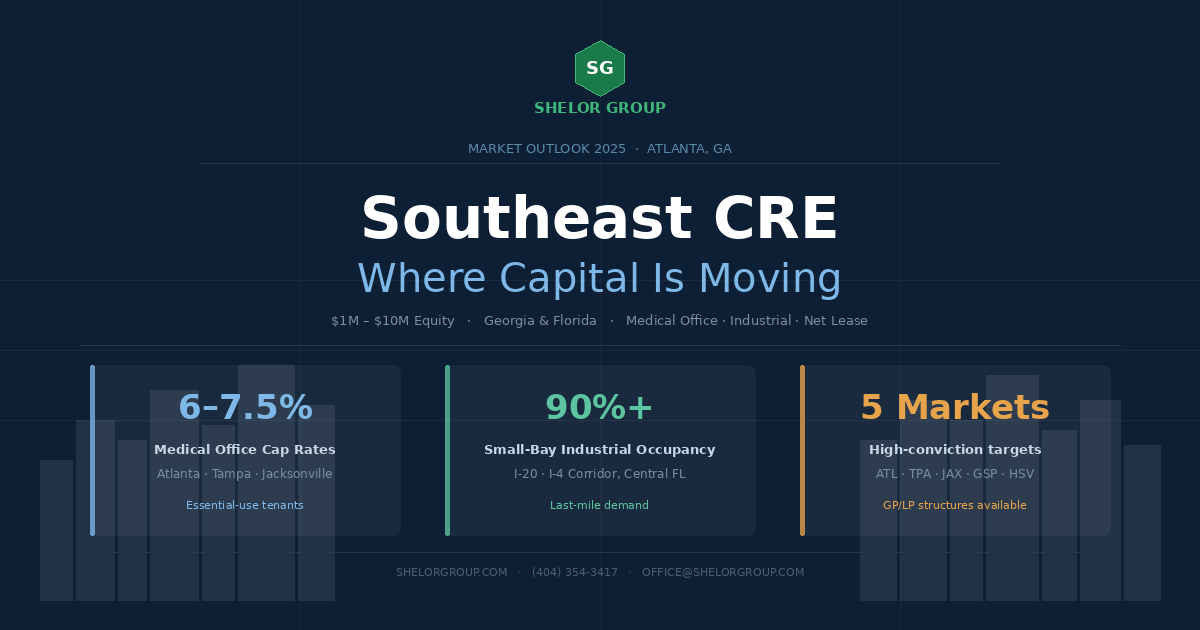
In Atlanta, Tampa, Jacksonville, and growing suburban markets like Alpharetta, Roswell, and Wesley Chapel, medical office vacancy rates are running well below the broader office market. For investors with $2M–$8M in equity, acquiring a single-tenant or multi-tenant MOB in a dense suburban location — particularly near hospital systems or urgent care corridors — offers stable cash-on-cash returns and strong downside protection. Cap rates for this asset class in the Southeast have been holding in the 6.0–7.5% range depending on tenancy and location.
Small-Bay Industrial and Last-Mile Distribution
E-commerce has permanently changed how goods move, and the Southeast is one of the most active industrial development corridors in the country. But the large format, 500,000-square-foot distribution centers are institutional plays. The opportunity for the $1M–$10M investor is in small-bay industrial — buildings between 5,000 and 40,000 square feet that serve local contractors, service businesses, and last-mile delivery operators.
Atlanta’s I-20 corridor, the I-4 corridor in Central Florida, and suburban markets around Nashville and Charlotte are seeing particularly strong demand for this product type. Tenants tend to be credit-stable small businesses with limited options to relocate, which supports rent retention. Investors are finding multi-tenant flex industrial properties in the $3M–$7M range with occupancy above 90% and manageable capex profiles.
Neighborhood Retail and Net Lease Anchored by Services
Retail is no longer a four-letter word in CRE, provided you’re looking at the right tenants. Service-oriented retail — dental practices, physical therapy, urgent care, childcare, quick-service food, and personal services — is highly resistant to e-commerce displacement. A customer cannot outsource their haircut or their child’s orthodontist appointment to Amazon.
In growing Southeast suburbs where rooftop counts are climbing, neighborhood retail centers with service tenants are trading at reasonable valuations relative to their cash flow. Single-tenant net lease assets with national credits — dialysis centers, pharmacies, urgent care brands — can be acquired in the $1.5M–$5M range and require minimal management intensity.
What to Avoid Right Now
Not every Southeast market is equally positioned. Here is where the capital is concentrating:
- Atlanta — North Fulton, Gwinnett, and Cherokee Counties: Population growth, strong healthcare infrastructure, and limited new supply of mid-size commercial inventory are creating real opportunity in the $2M–$6M range.
- Tampa Bay / St. Petersburg: One of the fastest-growing metros in the country. Medical office and service retail in Hillsborough and Pasco Counties are performing particularly well.
- Jacksonville, FL: An underrated market. Strong logistics and healthcare employment base. Pricing is more favorable than Tampa or Miami, making it accessible for sub-$5M deals.
- Greenville-Spartanburg, SC: Manufacturing and healthcare-driven growth, significantly less competition from institutional capital, and strong occupancy fundamentals across most asset classes.
- Huntsville, AL: Defense and aerospace sector is generating unusual income growth and housing demand, which is translating into commercial absorption across retail and service categories.
How the $1M–$10M Investor Accesses These Deals
The $1M–$10M equity range is not large enough to go direct on most of these acquisitions without leverage, and in many cases, the most efficient path is through a GP/LP structure. In these arrangements, an experienced general partner — a developer or operator with deep local market knowledge and an existing deal pipeline — sources and manages the asset. Limited partners contribute equity in exchange for a preferred return and a share of appreciation.
For investors who want direct ownership, the key is pairing with an advisory firm that has existing broker relationships in target submarkets, understands the capital stack options available at this deal size, and can structure the acquisition to optimize both cash flow and exit timing. Creative financing — including bridge-to-permanent structures, preferred equity, and seller financing in off-market deals — is increasingly important as traditional bank financing has become more selective.
What to Avoid Right Now
Not everything in the Southeast is performing. Traditional suburban office — multi-story, non-medical, Class B and C — is still working through a structural demand problem that is unlikely to resolve quickly. Large-format retail in secondary locations is similarly challenged. And any deal underwritten on aggressive rent growth assumptions in overbuilt multifamily submarkets — particularly parts of Austin, Phoenix, and even some Atlanta submarkets — warrants significant caution.
The deals that are working share common characteristics: essential-use tenants, strong demographic tailwinds, and a capital structure that does not require a refinance in the next 24 months to make the numbers work.
Final Takeaway
The Southeast CRE market in 2025 rewards investors who are specific. Broad statements about “buying in Atlanta” or “investing in Florida” are not a strategy. The investors generating consistent returns in this range are focused on a narrow set of asset types, in well-defined submarkets, with a clear thesis around tenant demand and exit timing.
If you are evaluating your first or next CRE investment in the Southeast and want to understand where the deals are and how to structure your capital, Shelor Group works with mid-size investors and development partners across Georgia and Florida to identify and structure exactly these kinds of opportunities. Reach out to begin a conversation.
—
Shelor Group | Atlanta, GA | (404) 354-3417 | Office@shelorgroup.com
Tags: commercial real estate investing Southeast, CRE deals Atlanta 2025, medical office investment Georgia, GP LP real estate structure, how to invest $1 million in CRE
